Nobody opens a chart calculator because they want to know what a "Heavenly Stem" is. They open it because of one question, usually phrased badly and always the same underneath: am I going to be all right?
Western horoscopes answer a different question, and this is not a criticism of them — it is a limit of their format. A sun sign is one of twelve, shared by roughly 600 million people, and a daily horoscope is written once and read by all of them. Nothing in that structure can be specific, so it survives by being unfalsifiable: broad enough that you nod, vague enough that you never catch it out.
Chinese astrology, the branch of it called BaZi (八字, "eight characters"), is built on the opposite principle. It cannot be vague, because it does not choose what to say — the birth moment does. That is the whole difference, and it is why the system is worth ten minutes of your attention even if you believe none of it.
Eight characters, and where they come from
A BaZi chart is four pairs of characters: the year, the month, the day and the hour you were born, each written as a Heavenly Stem over an Earthly Branch. Four pillars, eight characters — hence the name.
The animal everybody knows is one character out of eight. It is the branch of the year pillar, and it is the least personal part of the chart, because two people born sixteen years apart share it. The character that matters most is the day stem, the Day Master, which represents you and appears once in every sixty days of the calendar.
Laid out across all valid combinations, the four pillars allow 518,400 distinct charts — 720 valid year–month pairs, sixty day pillars, twelve hour branches. That number is why the reading can afford to be specific. It is not picking from a menu of twelve.
The four decisions most calculators skip
Specificity is not a claim, it is a set of computations. Four of them decide whether two calculators will even agree with each other:
- The year starts at the Start of Spring, not on 1 January. 立春 falls around 4 February. Anyone born in the first five weeks of a year is, in chart terms, still in the previous year.
- Months follow solar terms, not lunar months. The month pillar changes roughly every thirty days at a term boundary, which is not the same day as the new moon.
- Hours are two-hour branches, and the day can start at 23:00. The day pillar advances on the traditional reckoning, not at midnight.
- Local clock time is not solar time. Longitude, time zone and daylight saving all shift the hour pillar. In a country with one time zone and five geographic ones — China — the correction reaches two hours, which is an entire pillar.
Two calculators that disagree are almost never disagreeing about interpretation. They are disagreeing about arithmetic. Everything after this point assumes the arithmetic is right.
The part that answers "what happens next"
This is where the system earns its keep, and it is the piece Western birth charts mostly do not have in the same form: a clock.
BaZi adds two layers of timing on top of the birth chart.
| Layer | What it is | Resolution | How it is calculated |
|---|---|---|---|
| Luck Pillars (大运) | Ten-year periods, each a stem-branch pair, that change the environment your chart sits in | Ten years | Distance from birth to the nearest solar term, divided by three: three days equals one year |
| Annual Pillar (流年) | One pair per calendar year, arriving at the Start of Spring | One year | Fixed by the sexagenary cycle, identical for everyone alive |
Note what the first row means. The age at which your luck pillars turn is not chosen by a practitioner — it is arithmetic on your birth moment, down to the day. Someone born four days before a solar term starts their first period at a different age than someone born four days after. That is a specific, checkable, falsifiable claim about a system most people assume is improvised.
The honest framing is climate, not weather. A luck pillar does not say "you will change jobs in March". It says that for a defined stretch of years, one kind of pressure is stronger than another — and a reader's job is to say which domain that pressure lands in for this chart: work, money, family, the body, or the way you are seen.
A real chart, opened
Here is an actual output, not an illustration. Born 14 March 1991, 07:40, Chicago. Female.
| Pillar | Characters | Reading |
|---|---|---|
| Year | 辛未 | Yin Metal Goat |
| Month | 辛卯 | Yin Metal Rabbit |
| Day | 壬午 | Yang Water Horse — Day Master |
| Hour | 己酉 | Yin Earth Rooster |
Element distribution across the eight characters, weights included:
| Element | Share | Function in this chart |
|---|---|---|
| Metal | 32.3% | Produces the Day Master — the resource it draws on |
| Earth | 26.9% | Controls the Day Master — outside pressure and standards |
| Fire | 16.1% | What the Day Master controls — output, visibility |
| Wood | 14.0% | What the Day Master feeds — ideas, growth, effort spent |
| Water | 10.8% | The Day Master's own element — internal reserve |
Ren water, born in a Rabbit month: spring, wood, the season that drains water rather than filling it. Metal is doing the supporting at nearly a third of the chart; earth is doing the pressing at more than a quarter. The spring months cost this chart energy, and the metal in it is what it runs on. A reader does not need mysticism to say that — it falls out of the numbers. The sign itself — years, hours, imagery — is on the Goat's profile page.
The timing layer, from the same computation: luck pillars run forward, first period starts at age 7 years 5 months, and the second decade carries Rival over Wealth — a configuration the tradition reads as competition over resources, in a chart already short of its own element.
Now compare that with what a sun-sign reading could say about the same person. "Pisces: a period of change is coming." One of these two outputs contains information that could be wrong. Only the second is worth arguing with.
What it refuses to say
This list matters more than the positive claims, because it is where most of the industry loses the right to be taken seriously.
- No death dates, no life expectancy, no "dangerous year".
- No diagnosis, no serious illness, no organ, no "watch your liver in 2027".
- No divorce verdicts, no "this marriage will not last", no verdict on whether to have children.
- No accident predictions, no legal outcomes, no "you will win the case".
- No lottery numbers, no stock picks, no exact dates for meeting a specific person.
The reason is not caution, it is method. Every one of those claims describes a single event, and a single event cannot be tested against a chart — you get one sample, once, and no way to check the reasoning. A system that makes those claims is selling certainty, not structure. Structure is the only thing a chart can honestly offer: which years ask more of you, which domains absorb the pressure, and what your chart is short of while it does.
How to test it on yourself in ten minutes
You do not have to believe anything. Run the experiment instead.
- Get your chart computed with solar terms and true solar time. If a calculator asks only for a birthday and not a birth time, it is not computing a chart — it is looking up your animal.
- Write down three past years before you read anything. One line each, in your own words: what that year was actually about. This step is the whole experiment; skip it and you will rationalise whatever you read afterwards.
- Read the year notes for those three years. Take the earliest one first.
- Score honestly. Right domain and right direction counts as a hit. Right mood but no domain is a miss — "a challenging year" describes every year of every life.
A generic system scores about one in three by luck. A specific one should name the domain before you tell it which year hurt.
FAQ
Is BaZi fortune telling?
It is a calendar-based model with a timing layer, and it reads tendencies rather than events. The tradition itself assumes you can work with your chart — that is why the same structure is read differently by two people with different constraints. "Destiny" in the English translation of 命 is a mistranslation of something closer to "the material you were made from".
Do I need my exact birth time?
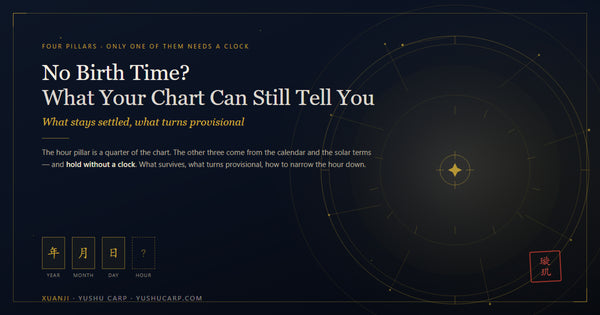
For all four pillars, yes — the hour pillar is a quarter of the chart and it is the layer that governs what you build. Without a time, you get three pillars and a chart with a quarter missing. If you know the hour but not the minute, that is usually enough; the branch changes every two hours.
Is it accurate?
Ask a narrower question: is it specific enough to be wrong? A reading that says your next decade is "a time of growth and change" is neither accurate nor inaccurate. A reading that says the pressure in a defined window lands on work and money, for a chart short of water, can be checked — and should be, against your own record rather than anyone's authority.
Do I have to be Chinese, or believe in anything, to use it?
No. The inputs are a date, a time and a place. Nothing in the calculation references ethnicity, religion or practice.
Can it tell me whether I will be rich?
No, and any page that says otherwise is guessing. It can describe whether your chart is built to accumulate or to circulate, and which decades support which — those are different questions, and only the second one is answerable.
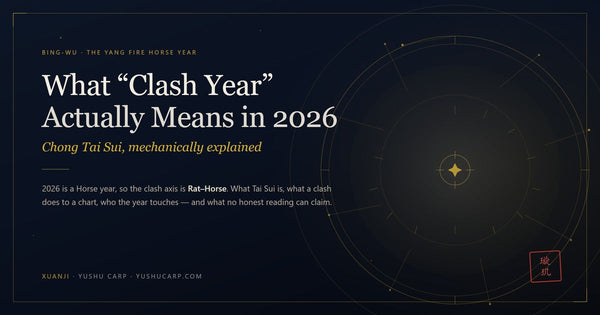
If you want to run the ten-minute test on yourself, the free reading computes your four pillars with solar terms, longitude correction and daylight saving, and it is free with no account. If you would rather start with the part almost everyone gets wrong, read why your zodiac animal is probably not what you were told. And if you want the chart in your hand rather than on a screen, the cards carry a numbered full report — one per card, computed the same way.