Short answer: People collect cards for four well-documented reasons — the pull of an unfinished set (the Zeigarnik effect), the reward of the reveal, the identity a collection signals, and the memory a physical object can hold. In 2026 the hobby added a fifth story, return on investment, and built an entire financial infrastructure around it. But the two largest surveys of collectors say that story is wrong about the people in it: 69% say collecting is not mainly about money, and 84% of Americans prefer physical objects to digital ones. The interesting question is not what a card is worth. It is what a card is for.
In June 2026, Collectr published the first State of the TCG Hobby mid-year report, built on more than 95 million sales records from 2023 to mid-2026, 900 million tracked items, and roughly 10 million collectors in over 100 countries. The headline sentence is not about cards. It is about infrastructure: "Five years ago, tracking the value of a card collection meant spreadsheets, forum threads, and guesswork. Today, the trading card game hobby operates with the infrastructure of a financial market: live pricing, population data, portfolio tracking, and millions of recorded transactions."
1. The hobby built a stock exchange
The numbers in that report are real and large. Tracked completed sales more than doubled in 2025, up 107% to 37.8 million, and the first half of 2026 had already recorded 28.0 million — roughly three quarters of the previous full year. The data comes from completed transactions on eBay, Fanatics Collect, Goldin and Heritage Auctions, covering raw singles, sealed product and graded cards. These are Collectr's own figures, not an audited market size, and the report says so.
What matters more than the growth is where the money sits. Graded cards account for 60% of tracked sales — more than raw singles (18%) and sealed product (22%) combined — and PSA alone holds 85% of graded sales. Sealed product appreciated 37% on average year to date, ahead of graded cards at 32%; the report reads that as evidence that collectors "increasingly treat unopened product as a store of value." One in five new collectors has never bought on eBay; those who convert to online marketplaces spend over $1,000 on average in their first month.
| What the 2026 data measures | What it says | What it cannot say |
|---|---|---|
| Collectr, State of the TCG Hobby (June 2026), 95M+ sales records | Tracked sales +107% in 2025; graded cards = 60% of tracked sales; sealed +37% YTD | Why any individual keeps a particular card |
| Seton Hall Sports Poll (Nov 2025), 1,564 U.S. adults, ±3% | 44% call collecting a financial investment; 69% say it is not mainly about money; 68% call it fun and a passion | How the same person answers both questions at once |
| Quad / The Harris Poll, Return of Touch (fielded Jul–Aug 2026), 2,004 U.S. adults | 84% prefer physical objects to digital; 79% of Gen Z say collecting makes them feel more connected to the real world; 68% of Americans collect physical items | Which object, and whose story it carries |
| The Card Shop Finder (Apr 2026) and CardVestr (Sep 2026) | Cards numbered to 50 or fewer take most premium dollars; base and mid-tier modern product is under sustained price pressure | Whether scarcity is the same thing as significance |
Read the table as a whole and a contradiction appears. The market measures price, population and print run with increasing precision. The people inside it keep describing something else.
2. Scarcity became a denominator
Walk a high-end card show in 2026 and the conversation has narrowed to a fraction. Trade coverage reports that cards numbered to fifty or fewer are pulling the lion's share of premium dollars, and that most new record sales are tied to print runs of fifty or below. The reason collectors give is pure arithmetic: "A card numbered to ten can never have a Pop 11 in PSA 10." Scarcity is the only thing that holds, because flagship print runs keep growing while the population of a low-numbered card is fixed forever.
At the same time, market intelligence from September 2026 describes a split: ultra-low-numbered parallels and true one-of-ones hold up because they cannot be reproduced, while base and mid-tier modern product faces sustained pressure from oversupply — modern sets now carry dozens of parallel tiers, and a single major sport's season can produce hundreds of millions of cards. The rational response inside that logic is to chase a smaller and smaller denominator.
But a denominator is a statement about supply, not about a person. It tells you how many exist. It never tells you why this one should stay.
3. The collectors disagree with the market
The November 2025 Seton Hall Sports Poll is the sharpest available check on the investment narrative. It surveyed 1,564 U.S. adults, matched to Census percentages, with a 3% margin of error. Forty-four percent agreed that collecting sports memorabilia is a financial investment — the number that gets quoted. In the same poll, 69% of collectors said it is not mainly about money, and 68% of those interested in collecting called it "fun and a passion," a higher share than the investment answer. Sports cards are the most collected item, at 51% of collectors; 23% of U.S. households collect sports memorabilia, and 18-to-34-year-olds are nearly twice as likely to do so as those 55 and older (30% vs 17%).
A second, independent study points the same way. Quad and The Harris Poll's 2026 Return of Touch report, fielded across 2,004 U.S. adults, found that 84% of Americans prefer physical objects to digital ones and 79% of Gen Z say collecting makes them feel more connected to the real world. Among the 68% of Americans who collect physical items, the stated drivers are nostalgia (46%), tactile interaction (42%) and self-expression (40%). The reporting on that study is explicit: resale value is not the engine. The Guardian's August 2026 coverage of the CD revival quotes a brand strategist on the same shift — streaming and wireless audio "took away the haptic, sensorial quality" of listening, and choosing an object rather than being directed by an algorithm has growing appeal.
Psychology has said this for a century. The Zeigarnik effect, first described in the 1920s, is the discomfort of an unfinished task: hold eleven of twelve and the twelfth becomes urgent. Uncertainty before a reveal drives a dopamine response; a collection signals identity and taste; an object held in the hand anchors a memory that no cloud folder can quite carry. None of these require a price guide. All of them are damaged when the price guide becomes the point.
4. A real scene, and the question it raises
Consider a specific case. Someone born in the last week of January or the first weeks of February is routinely told the wrong animal, because a calendar that turns the year on 1 January does not match the boundary the zodiac year actually uses. Roughly one in twelve people are affected. We use the solar-term (lichun) boundary; the lunar-new-year convention is also widely used, and both rules are documented in the open dataset behind our charts.
Now imagine giving that person a card. A rare parallel would give them a fraction: 12/50, a position in a supply schedule. A different kind of card gives them an address: a serial number bound to their own birth data, and a reading computed once, frozen, and stored as a snapshot rather than recalculated every time the page is opened. Ten years from now the graded-slab market will have repriced itself many times over. The fact that this person was born on that date, and that someone once checked it carefully for them, will not have moved at all.
That is the part a population report cannot count: a card that is about the person holding it.
5. A different kind of number
We make XUANJI zodiac cards, so this is where we declare our interest. We built them around the second kind of number, and we would rather say plainly what that means than imply anything about value.
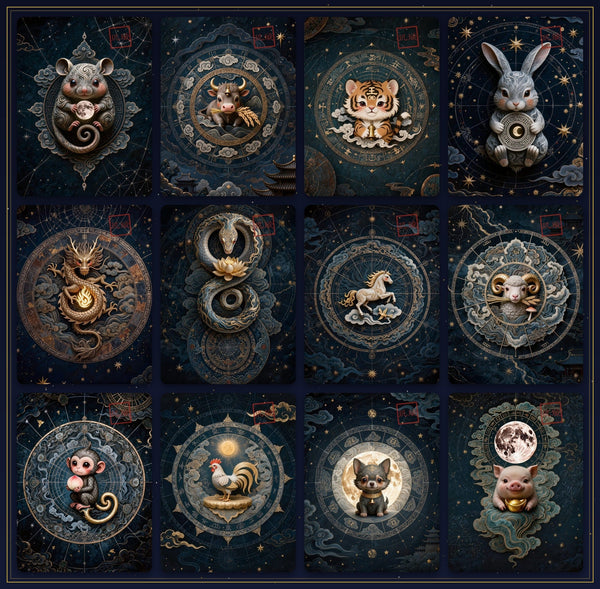
The first run is 600 cards, fifty of each animal, numbered 00001–00050 per sign. If a later run follows, the numbering continues in sequence; the first 600 stay the lowest numbers ever printed. That is a fact about production, honestly stated, not a forecast. Each card's content belongs to one person: the reading it opens is computed from the owner's birth data and bound to that serial number. The report is stored as a frozen snapshot, so the card says the same thing in year ten as it did on the day it was made. A card can change hands up to three times in its lifetime, tracked on its own record — the gift stays alive rather than becoming a dead object in a drawer. Twelve animals make a set designed to be finished: a household with four birth years is four cards on one binder page, and every card is about the person holding it.
And because a hobby that asks you to trust a stated print run and a grading company deserves an alternative, the engine is published. The boundary dataset behind every chart — every spring-boundary day from 1900 to 2100, and the rule that decides which animal a birth date belongs to — is open-sourced under an MIT licence, and the report page has a "show the math" link that displays the actual computation. You do not have to take our word for the calendar.
We do not operate a secondary market, make no claim about future value, and say in writing that this is a cultural object, not an asset. In a year when "sealed product as a store of value" is a headline finding, that refusal is not a marketing pose. It is the only way the number can stay an address.
6. How to start a collection that means something
You do not need our cards to do any of this. Four things are enough, and they work with whatever you already own:
Keep one object per person, not per price tier. Choose the item that points to a specific human being and a specific moment, and write down why you chose it. A collection with reasons attached outlives a collection with comps attached.
Finish something small. The Zeigarnik effect is real, but it is satisfied by a complete twelve, not by an infinite ladder of parallels. A set with an edge is a set you can actually hold in your hands and hand to someone else.
Prefer objects that can be checked. Provenance you can audit — a serial number, a dated record, an open method — beats a claim you have to trust. Ask what the maker is willing to show you.
Give it away while you are alive to see it. The most durable collectible is the one that carries a relationship. A card that remembers it was yours, and still works for the next person, is doing more than a slab in a safe.
Start with one person. Check which animal their birth date actually belongs to — the free reading needs no signup, and about one in twelve people get a different answer than they expect. Write down the date you checked. Then, if you want a physical object to hold that answer, give them a card with a number on it. Not because the number will be worth more. Because, ten years from now, it will still be the only one that is theirs.
The market will keep pricing cards. That is fine. Just do not let it decide which ones you keep.
FAQ
Why do people collect trading cards?
Four documented drivers: the pull of an unfinished set (the Zeigarnik effect), the reward of an uncertain reveal, the identity and community a collection signals, and the memory a physical object holds. In the November 2025 Seton Hall Sports Poll, 68% of those interested in collecting called it "fun and a passion" and 69% of collectors said it is not mainly about money — a higher share than the 44% who called it a financial investment.
Is card collecting a good investment?
We do not give investment advice, and we make no claim that any card will appreciate. Collectr's June 2026 report shows graded cards at 60% of tracked sales and sealed product up 37% year to date, but it also describes a split market in which base and mid-tier modern product is under sustained price pressure. Price data describes transactions; it does not describe why a person keeps an object.
What does a numbered card actually tell you?
Usually a denominator: how many copies exist. That is a fact about supply. A number can instead be an address — pointing to one person, one birth date and one computation frozen at a moment in time. The first kind supports a price; the second supports a memory.
Why are physical collectibles growing in a digital world?
Quad and The Harris Poll's 2026 Return of Touch study (2,004 U.S. adults) found 84% of Americans prefer physical objects to digital ones, and 79% of Gen Z say collecting makes them feel more connected to the real world. The stated drivers are nostalgia (46%), tactile interaction (42%) and self-expression (40%) — not resale value.
Sources
Collectr, State of the TCG Hobby: 2026 Mid-Year Report (published June 2026; figures as of June 2026; 95M+ sales records, 2023–H1 2026). Seton Hall Sports Poll, Collecting Sports Memorabilia is a Financial Investment and a Hobby (conducted 9–10 November 2025, 1,564 U.S. adults, ±3%). Quad / The Harris Poll, Return of Touch: The Human Advantage (2026; 2,004 U.S. adults, fielded 23 July – 12 August 2026). The Card Shop Finder, Why Numbered Parallels Are Dominating the 2026 Hobby (21 April 2026). CardVestr, Daily Market Intelligence Brief (21 September 2026). The Guardian, 'It brings me joy': how young people are making CDs cool again (22 August 2026).
Related reading: Chinese Zodiac Cards for Collectors: Card Size, Serial Numbers, and the First 600 · Open data: github.com/hengwenpu/chinese-zodiac-year-boundary · The cards: yushucarp.com