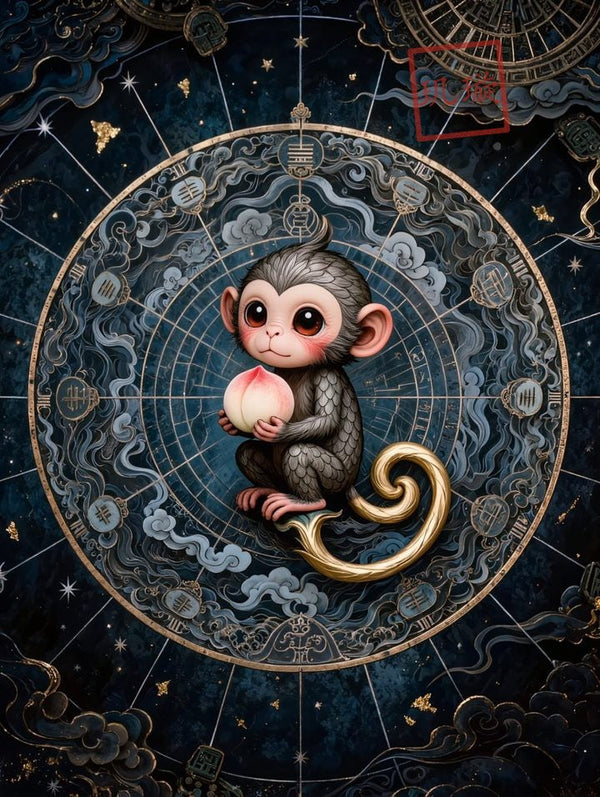
Tiger compatibility is the easiest of the twelve to get wrong, because the Tiger looks self-sufficient. It is not. The traditional tables give the Tiger a six-harmony partner almost nobody predicts — the Pig — and, on the other side, the most loaded set of difficult relationships in the whole cycle: a clash and a harm that both sit inside the same three-sign punishment triangle.
That asymmetry is worth understanding on its own terms. The Tiger does not struggle with people who move fast; it struggles with people who calculate. Every pairing below turns on that distinction.
The short answer
| Relationship | Sign | Traditional reading | In real life |
|---|---|---|---|
| Six harmony (strongest) | Pig | 寅亥合 · the Tiger's classic match | Drive meets support with no conditions attached |
| Trine (easy) | Horse | 寅午戌 · fire triangle | Two signs that both act first |
| Trine (easy) | Dog | 寅午戌 · fire triangle | Shared instinct for loyalty and cause |
| Clash | Monkey | 寅申冲 · opposite branch | Directness against calculation |
| Harm | Snake | 寅巳害 · quiet friction | Silence read as withholding |
One structural note that most compatibility pages leave out: Monkey and Snake are the other two members of the 寅巳申 punishment triangle, which means the Tiger's two difficult relationships are not separate incidents. They are the same tension wearing two faces — the Tiger against any sign that prefers to work out the angles before it moves. The general geometry is set out in the four compatibility triangles.
Tiger and Pig: the six-harmony exception
The Pig is the last sign anyone expects to be paired with the Tiger. Soft where the Tiger is loud, patient where the Tiger is impulsive, allergic to conflict where the Tiger goes looking for it. The tables call them a six harmony anyway, and the reason is supply: the Tiger spends energy recklessly and the Pig holds deep reserves it gives away without keeping score.
What the Tiger finds in the Pig is the rarest thing in its life — a person it does not have to perform for and cannot intimidate. What the Pig finds in the Tiger is protection without negotiation. The failure mode is entirely on the Pig's side: it over-functions quietly until it is running the Tiger's life, and the Tiger, who never asked, notices last. A workable Tiger–Pig arrangement names the division out loud: the Tiger takes the risks, the Pig owns the base, and neither claims the other's territory.
Horse and Dog: the fire triangle
Tiger, Horse and Dog form the fire trine — the three signs the tradition groups as initiators bound by instinct rather than procedure. Tiger plus Horse is pure velocity: two signs that would both rather start badly than wait. Tiger plus Dog adds something the Tiger usually lacks, which is a line it will not cross. Dogs give the Tiger a cause rather than a plan, and Tigers are far more reliable with a cause.
The triangle's shared weakness is that none of the three is a natural auditor. Fire-trine groups make decisions enthusiastically, in sequence, without anyone re-reading the map. High-performing teams of this shape survive by appointing one person to be the brake on purpose — usually the Dog, who is the only member who will say "we agreed not to do this."
Tiger and Monkey: the clash of method
Traditional tables pair the Tiger with the Monkey as a clash — opposite branches on the wheel. The version usually printed is that the Monkey is too clever for the Tiger. The truer version is about information: the Monkey works out the angles first and reveals its reasoning later, while the Tiger states its intention out loud and moves. To the Tiger, the Monkey's delay reads as evasion. To the Monkey, the Tiger's speed reads as not having thought about it.
Both readings are unfair, and both contain something. The pairing improves the moment either one volunteers its reasoning before it is asked — the Monkey saying "I need two days because of three specific things," the Tiger saying "I am moving on Thursday, tell me now if that breaks something." The clash is not about pace. It is about whether thinking is visible.
The Snake: the harm that says nothing
The harm between Tiger and Snake is the quietest of the Tiger's relationships and in some ways the most corrosive. The Snake is private by nature and sees no reason to narrate; the Tiger reads silence as either agreement or withholding, and usually guesses wrong. So the Tiger fills the silence with its own interpretation, states it with total confidence, and the Snake — who was simply thinking — registers being misread and withdraws further.
This is the one pairing where the Tiger should ask rather than announce. A single question, asked plainly and left to sit unanswered for a day, does more for a Tiger–Snake relationship than any amount of directness, because the Snake needs time to decide what it is willing to say. Note that this harm and the Monkey clash come from the same structural place, which is why the same Tiger often reports both problems at once.
The Tiger's weak spot
The Tiger's trade is speed for permission: it acts, and negotiates afterwards, because asking first feels like asking to be slowed down. The cost is that the Tiger ends up spending its authority on things it did not need to spend it on, and finds out late which of its decisions other people were quietly undoing.
Three sentences the Tiger can adopt without losing momentum:
- "Here is what I am about to do — object now, not later" — speed with a five-minute window in it.
- "Which part of that did you disagree with?" — asked after the decision, which the Tiger finds tolerable.
- "I was wrong about the timing, not the direction" — the sentence that keeps a Tiger credible when it changes course.
A Tiger that announces its intentions is not a slower Tiger — it is a Tiger whose speed other people can plan around. For the sign's full profile — years, hours, the old stories — see the full Tiger profile.
FAQ
Who is the Tiger's best match?
The Pig, according to the traditional tables — a six-harmony pair in which the Pig's unconditional reserves meet the Tiger's drive. It is the least obvious pairing in the cycle and the one classical sources rate highest for the Tiger, because the Pig is the only sign that neither competes with the Tiger nor flinches from it. The Horse and the Dog follow as fire-trine partners: faster, louder, and more likely to escalate together.
Why do Tiger and Monkey clash?
They sit on opposite branches, and the friction runs through visible versus invisible thinking. The Monkey calculates privately and reveals conclusions; the Tiger declares intentions and moves. Each reads the other's method as a character flaw rather than a style. Pairs who put their reasoning on the table before decisions — not after — find the clash converts into a genuinely effective division of labour.
Does the element year change compatibility?
It changes emphasis, not the table. A 1986 Fire Tiger and a 2022 Water Tiger share the branch and therefore the same pairings, but the classical reading gives the fire year more visible drive and the water year more patience and calculation. Pairing questions stay answered by the branch; element years explain why two Tigers you know behave nothing alike.
Want your own pairing map rather than the generic one? Check your own chart — sign, hour and element, computed the classical way. If you prefer to hold it in your hand: the Tiger card carries the full reading inside a numbered collectible.