If you have ever looked up rat compatibility, you have seen the same three words repeated everywhere: Ox, Dragon, Monkey. The repetition is deserved. In the traditional system the Rat's strongest partner is the Ox — a six-harmony pair — followed by the Dragon and the Monkey, its two partners in the water triangle. On the difficult side sit the Horse (the classic clash) and the Goat (a quieter friction called a harm).
None of this is a prediction about any particular couple. Read it as a temperament map: which rhythms fit together easily, and which ones take deliberate work. That is how the classical tables were meant to be used — not as fortune-telling, but as a shorthand for "how do these two operating styles share a room."
The short answer
| Relationship | Sign | Traditional reading | In real life |
|---|---|---|---|
| Six harmony (strongest) | Ox | 子丑合 · the Rat's classic match | One generates ideas, the other finishes them |
| Trine (easy) | Dragon | 申子辰 · water triangle | Two strategists who enjoy each other's pace |
| Trine (easy) | Monkey | 申子辰 · water triangle | Quick minds, playful competition |
| Clash | Horse | 子午冲 · opposite branch | Speed meets open ground; neither is wrong |
| Harm | Goat | 子未害 · quiet friction | Slow drain, not loud conflict |
Where does this come from? The twelve branches are not twelve separate personalities; they sit on a wheel, and their positions create geometry — triangles of three that share a phase, opposite pairs six steps apart, and subtler diagonal frictions. If you want the whole structure in one page, read the four compatibility triangles first, then come back to the Rat's specifics.
Why the Ox is the Rat's strongest match
The Rat is the first branch, the Ox the second, adjacent on the wheel — and adjacent pairs that combine productively are called six harmonies. The Rat thinks in options; the Ox thinks in commitments. The Rat scans for openings; the Ox locks a door so what is already inside can grow.
In practice this shows up as division of labor that neither has to negotiate: the Rat proposes three directions before breakfast, and by evening the Ox has quietly built the one that made sense. The friction points are equally predictable. The Rat can find the Ox slow and unmoved by novelty; the Ox can find the Rat restless and allergic to finishing. The pairing works when both treat those traits as features being purchased, not bugs being tolerated.
Dragon and Monkey: the same triangle
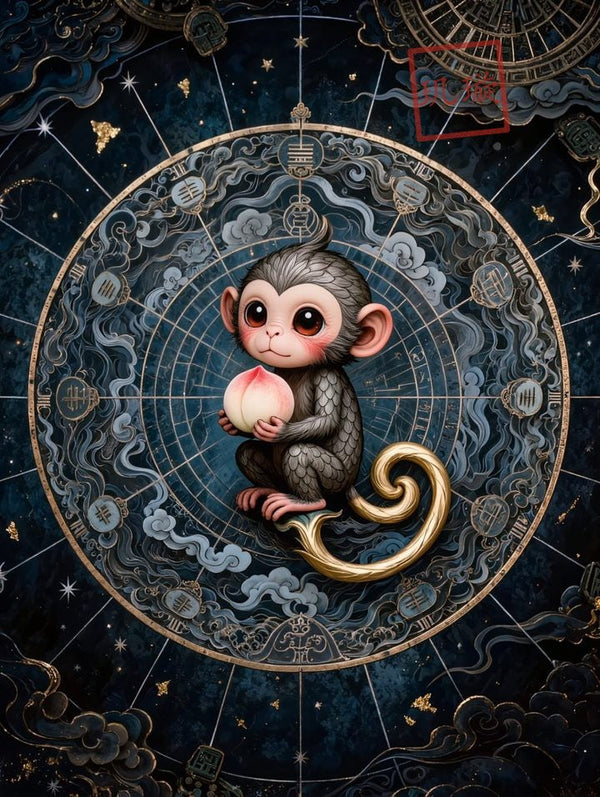
Rat, Dragon and Monkey form the water trine — three signs held to share an appetite for finding the angle no one else sees. A Rat–Dragon pair runs on ambition and momentum; a Rat–Monkey pair runs on wit and mutual entertainment. Both are easy in a way Rat–Ox is not: nobody has to translate.
The shared weakness of the triangle is execution. Three people who love openings more than endings can spend years almost-starting. In a two-person version, the Rat–Dragon couple is well advised to borrow an Ox somewhere — a business partner, a builder, anyone who enjoys the unglamorous middle of a project.
The Horse clash, honestly explained
Traditional tables pair the Rat with the Horse as a clash — opposite points on the wheel. Read it as a temperament note, not a verdict: the Rat moves by watching, timing and small advantage; the Horse moves by going, openly, and expects company. One needs cover; the other needs open ground.
Three things make this pairing work when it works:
- Let the Horse move first and stop promising to optimize the route. The Rat's timing advice lands as criticism at Horse speed.
- Give the Rat a domain it fully controls — money, planning, research — so it does not have to hover over the Horse's decisions.
- Agree in advance on which decisions are joint. Vetoing mid-action is what makes a clash feel like a war instead of a difference.
Plenty of durable Rat–Horse partnerships exist. The wheel describes friction, not fate.
The Goat: the quieter difficulty
The harm between Rat and Goat is harder to spot than a clash, because nobody is shouting. The pattern: the Rat, quick to please and quick to calculate, over-commits in the moment — and the Goat, who took the promise literally, quietly registers each walk-back. Nothing explodes. Something erodes.
The fix is unromantic but effective: the Rat should promise slower, in smaller units. "I'll handle it by Friday" beats an enthusiastic "sure, leave it to me" whose deadline the Rat has already internally renegotiated.
If you were born a Metal Rat, not a Wood Rat
The cycle runs on twelve signs crossed with five elements, so a "Rat" is not one type but a repeating family with different emphases:
| Year | Rat type | Usual emphasis |
|---|---|---|
| 1984 | Wood Rat | Expansive, cooperative, growth-minded |
| 1996 | Fire Rat | Expressive, persuasive, quicker to commit publicly |
| 2008 | Earth Rat | Steadier, more deliberate, longer horizons |
| 2020 | Metal Rat | Sharper-edged, more exacting about standards |
The element does not change the compatibility table — a Metal Rat still trines with Dragon and Monkey. It changes the emphasis: the same clash with the Horse reads as restlessness in a Fire Rat and as rigidity in a Metal one. For the full sign profile beyond compatibility — years, hours, the classical lore — see the full Rat profile.
FAQ
Who is the Rat's best match?
In the traditional tables, the Ox — the Rat's six-harmony partner, where quick thinking meets steady execution. The Dragon and Monkey come next as the Rat's trine partners: same tempo, shared appetite for strategy, less of the Ox's ballast. All three are listed as strong matches; the Ox is simply the one the almanacs single out.
Is the Horse really the Rat's worst match?
The Horse is the Rat's classical clash — opposite branches — so the tables flag friction. Friction is not doom. It means the pair's default rhythms compete: one watches and times, the other runs in the open. Rat–Horse pairs who explicitly divide domains and pre-agree on joint decisions often do fine; the clash is a maintenance schedule, not a sentence.
Does my birth year's element change my compatibility?
Not the table itself — Rat, Ox, Dragon and the rest hold their traditional relations regardless of element. What the element changes is flavor: a 1984 Wood Rat and a 2020 Metal Rat are both Rats, but one emphasizes growth and cooperation while the other emphasizes precision. Same map, different seasoning.
Want to see where you actually sit? Check your own chart — your sign, your hour, and the pairings that surround it, computed the classical way. And if you prefer something you can hold: the Rat card carries the full reading inside a numbered collectible.