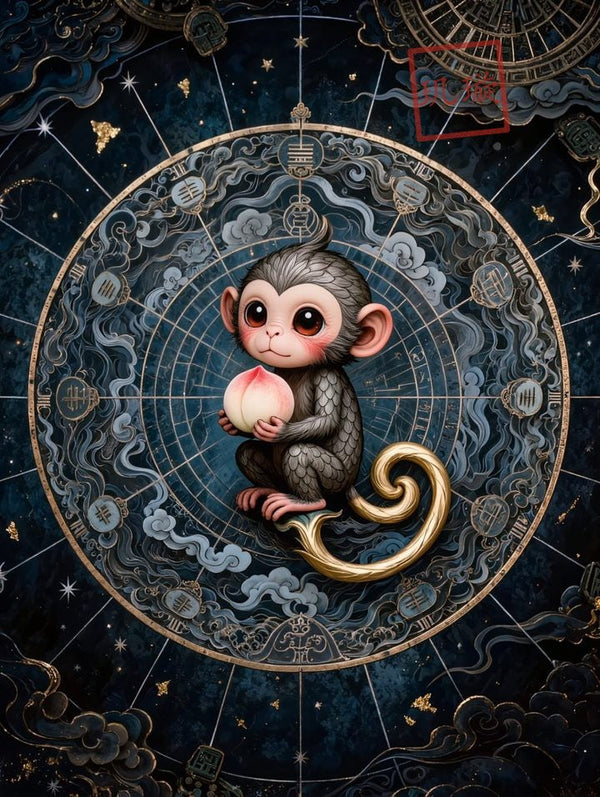
Snake compatibility starts with a surprise. The tables pair the most private, most self-contained sign in the cycle with the Monkey — the quickest, most playful one — and call it a six harmony. That is not a typo. 巳申合, the combination between the Snake branch and the Monkey branch, is one of the classical pairings, and it works for the same reason unlikely pairs often do: each supplies what the other refuses to develop in itself.
Around that central pairing, the Snake sits in the metal triangle with the Ox and the Rooster, clashes with the Pig, and carries a quiet harm with the Tiger. Each relationship traces back to one trade: the Snake gives up exposure and takes back control, and it does best with signs who neither demand the first nor threaten the second.
The short answer
| Relationship | Sign | Traditional reading | In real life |
|---|---|---|---|
| Six harmony (strongest) | Monkey | 巳申合 · the tables' surprise pairing | One improvises, one vetoes |
| Trine (easy) | Ox | 巳酉丑 · metal triangle | Two private signs, shared standards |
| Trine (easy) | Rooster | 巳酉丑 · metal triangle | Mutual respect for precision |
| Clash | Pig | 巳亥冲 · fire against water | Openness floods privacy |
| Harm | Tiger | 寅巳害 · quiet friction | The Snake is read without consent |
These positions come off the twelve-branch wheel — a six-harmony between neighbouring branches, a triangle of three sharing a phase, an opposite pair six steps apart, a diagonal harm. The full structure is laid out in the four compatibility triangles.
Snake and Monkey: the harmony with a catch
On paper nothing about this pairing looks reasonable. The Monkey thinks out loud, changes plans at noon, and treats seriousness as optional. The Snake plans in silence, finishes what it starts, and treats words as commitments. But the six harmony exists precisely because the gap is total: the Monkey gets an audience who actually listens and remembers, and the Snake gets a window into a kind of lightness it would never practise on its own.
Here is the detail almost no compatibility page mentions: 巳申 is also part of the three-penalty triangle with the Tiger — the same branches that combine also strain. The tradition calls this a combination with friction built in, and it is a more honest description than most. The Snake–Monkey pairing is attractive and irritating by design: the Monkey's looseness reads to the Snake as unreliability, the Snake's monitoring reads to the Monkey as surveillance. Pairs who name this early — "I will improvise, you verify" — turn the built-in strain into a working division of labour.
Ox and Rooster: the metal triangle
Snake, Ox and Rooster form the metal trine — three branches the tradition associates with precision, judgement and craft. An Ox–Snake pair is nearly silent from the outside: both signs would rather say nothing than say something imprecise, and both treat loyalty as a private fact rather than a public performance. The Snake should know that the Ox's steadiness is not dullness; the Ox should know that the Snake's silence is not scheming.
A Snake–Rooster pair shares an eye for what is wrong with the room. Both notice the flaw first and the person second, which makes them efficient colleagues and occasionally merciless hosts. The pairing holds when criticism is rationed — one standard per conversation — and fails when two perfectionists audit each other daily.
Snake and Pig: the clash of climates
Snake and Pig sit opposite on the wheel — 巳亥冲, fire against water, and in temperament, privacy against openness. The Pig is the sign that shows everything: feelings, plans, the state of its heart, unprompted. The Snake is the sign that shows almost nothing and notices everything. Neither is wrong; each experiences the other as a change of climate.
The practical failure mode is specific. The Pig reads the Snake's reserve as rejection and compensates with more openness, which the Snake experiences as pressure. The Snake reads the Pig's transparency as naivety and compensates with more reserve, which the Pig experiences as punishment. Pairs who break the loop do it by trading currencies: the Snake says one true thing out loud per day, and the Pig accepts that this is the whole vault opening.
The Tiger: the harm that reads without asking
The harm between Tiger and Snake is quiet and specific: the Tiger is large, fast and certain, and simply reads the Snake — announces what the Snake is thinking, decides what the Snake wants — without noticing that being read is exactly what the Snake guards against. Nothing cruel is said. The Snake just finds itself increasingly described, in rooms it did not consent to be described in.
The repair is a single sentence, delivered without heat: "Ask me before you conclude." Tigers respect directness and respond to it; what they do not register is the slow withdrawal they cannot see. Note that Tiger, Snake and Monkey form the three penalties together — if you arrived here from the Tiger article, this is the same triangle seen from the Snake's side.
The Snake's weak spot
Every sign's pairing pattern traces back to a single trade. The Snake trades exposure for control: it stays unread, and calls that safety. The cost is slow — partners end up loving a curated surface, and the Snake ends up lonely inside a relationship that looks complete from outside.
Three sentences the Snake can adopt without becoming a different person:
- "Here is what I actually want" — said once, early, before the curated version hardens.
- "I noticed, and I am not going to use it" — the difference between perception and leverage.
- "You are not in trouble; I was quiet because I was thinking" — which costs the Snake nothing and saves the Pig, the Monkey and everyone else months of guessing.
A safer Snake is not a more exposed Snake — it is one whose reserve is legible instead of alarming. For the sign's full profile — years, hours, the old stories — see the full Snake profile.
FAQ
Who is the Snake's best match?
The Monkey, according to the traditional tables — a six-harmony pairing in which the Monkey's speed and lightness supply exactly what the Snake's control cannot, and the Snake's depth gives the Monkey's improvisation somewhere to land. The Ox and the Rooster follow as the metal-trine partners: quieter, built on shared standards rather than complementary ones.
Are Snake and Monkey really compatible, given the penalty?
Both, and that is the point. The same branches that form the six harmony also participate in the three penalties with the Tiger, which the classical texts acknowledge as a combination with friction built in. In practice the pairing is attractive and irritating by design: it works when the division of labour is explicit — one improvises, one verifies — and stalls when each treats the other's core style as a bug to be fixed.
Why do some pages say the Snake is a "little dragon"?
The hour and the imagery, not the compatibility tables. 巳, the Snake's branch, was associated with mist and emerging warmth, and the snake's shedding skin made it a symbol of renewal — hence "the little dragon" in classical commentary. The nickname is descriptive; the pairing system runs on the branch positions, which are identical whether you call it Snake, little dragon or serpent.
Want your own pairing map rather than the generic one? Check your own chart — sign, hour and element, computed the classical way. If you prefer to hold it in your hand: the Snake card carries the full reading inside a numbered collectible.